Disconnected by Design: Why Remote Chemistry Collaboration Is Broken — and What Leading Institutions Are Doing About It
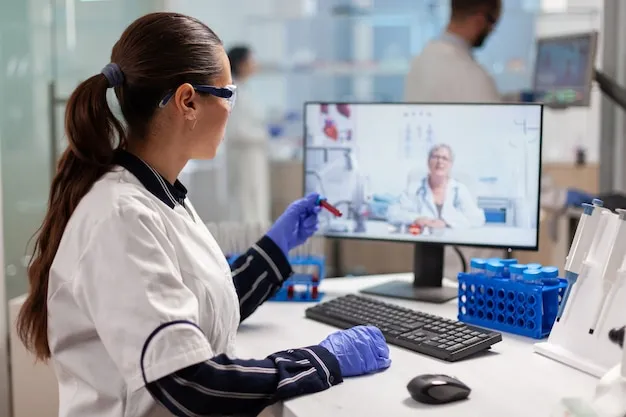
Photo: scientists remote video call laboratory collaboration technology, via img.freepik.com
When the pandemic forced research institutions across the United States to shutter their physical laboratories in 2020, the chemistry community pivoted to remote collaboration with a confidence that, in hindsight, may have been premature. Video conferencing platforms, shared cloud notebooks, and digital spectroscopy dashboards were assembled into makeshift workflows almost overnight. Four years later, a quieter reckoning is underway: for many research teams, those tools never quite worked — and the scientific costs are beginning to surface.
This is not a story about technology failing chemists. It is a story about chemistry being fundamentally misunderstood by the platforms designed to support it.
The Serendipity Problem Nobody Talks About
Ask any experienced bench chemist about their most significant discoveries, and a striking number will describe a moment they did not plan. A colleague leaning over to examine an unexpected color change. A hallway exchange that reframed a months-long hypothesis. The shared frustration over a failed synthesis that, voiced aloud, triggered an entirely new approach.
These moments — often dismissed as anecdotal — are increasingly recognized by organizational researchers as structurally essential to scientific progress. A 2022 study from the National Bureau of Economic Research found that co-located research teams produced significantly more novel patent citations than their remote counterparts, even when controlling for funding levels and institutional prestige. For disciplines like chemistry, where physical intuition and real-time observation are embedded in the methodology itself, the gap is especially pronounced.
Virtual collaboration tools were not designed to reproduce this. They were designed to reproduce meetings.
Where the Tools Fall Short
The shortcomings of current remote chemistry infrastructure fall into two broad categories: practical and psychological.
On the practical side, the limitations are straightforward. Remote researchers cannot share a fume hood. They cannot observe the viscosity of a solution, smell an unexpected byproduct, or intervene when a reaction behaves anomalously. Even the most sophisticated remote-access instrumentation — robotic synthesis platforms, cloud-connected NMR systems, and AI-assisted spectral analysis — cannot replicate the embodied knowledge that accumulates through physical proximity to experimental work.
The psychological barriers are subtler but arguably more damaging. Research teams operating across time zones and home offices report consistent declines in what organizational psychologists call "psychological safety" — the shared sense that team members can voice half-formed ideas, admit confusion, or challenge assumptions without professional consequence. In a physical lab, that safety is cultivated through dozens of low-stakes daily interactions: shared meals, equipment troubleshooting, the casual debrief after a failed experiment. Strip those interactions away, and what remains is a series of structured check-ins that reward polish over candor.
"When everything is on the record and on camera, people self-edit," notes one research director at a major Midwestern university, who asked not to be named due to institutional sensitivity. "You lose the rough draft of science — the part where people think out loud."
The Hybrid Correction
A growing number of US research institutions are moving away from fully distributed models and toward what they are calling "intentional hybrid" frameworks — structures that do not simply split the week between home and office, but deliberately engineer the conditions under which in-person time is used.
At one prominent R&D-focused chemical company in the mid-Atlantic region, leadership restructured its collaborative calendar after an internal audit revealed that most remote meeting time was spent on status updates that could have been asynchronous. In-person days were redesigned around activities that specifically require physical co-presence: experimental planning sessions, instrument training, and what the team now calls "collision hours" — unstructured time in shared lab spaces with no agenda other than proximity.
The results, while still early, have been encouraging. The team reported a measurable increase in cross-disciplinary project proposals within the first two quarters of the restructured model.
Emerging Technologies Worth Watching
Several technology developers are beginning to address the practical gaps in remote chemistry collaboration with tools that go beyond screen sharing.
Haptic feedback systems, once the province of surgical training simulations, are being adapted for laboratory environments. Early-stage platforms are exploring how force-feedback gloves might allow a remote chemist to "feel" the resistance of a manual titration or the texture of a precipitate — crude approximations, but directionally significant.
Digital twin technology, which creates real-time virtual replicas of physical laboratory environments, is attracting investment from both academic institutions and private chemical manufacturers. These systems allow distributed team members to observe live experimental conditions through synchronized sensor arrays, reducing the informational gap between those physically present and those working remotely.
Perhaps most promising is the application of spatial audio and ambient presence platforms — tools that recreate the acoustic texture of a shared workspace, allowing remote researchers to hear the background activity of a lab environment without being actively addressed. Preliminary user research suggests that ambient presence significantly reduces the social isolation that undermines remote team cohesion over time.
Building a Network That Bridges the Gap
For individual researchers and team leaders navigating distributed environments today, the most actionable insight from current evidence is also the most counterintuitive: the solution to remote collaboration failure is not better remote tools. It is more deliberate investment in the relationships that make collaboration possible in the first place.
Platforms like ChemsConnect exist precisely because the professional networks that once formed organically in departmental corridors and conference exhibition halls have become harder to sustain. When researchers are distributed across institutions, time zones, and industry sectors, the connective tissue of the scientific community requires active maintenance — not passive assumption.
The chemistry community has long understood that reactions require the right conditions. The same principle applies to collaboration. Temperature, pressure, and catalyst matter in a flask; trust, proximity, and shared purpose matter in a research team. Remote work, as currently practiced, often provides none of the latter three in sufficient concentration.
A Field at a Crossroads
The remote collaboration experiment in chemistry is not over — nor should it be. Geographic flexibility has opened research careers to scientists who would otherwise be excluded by location, caregiving responsibilities, or institutional access. That is a genuine and important gain that no thoughtful analysis should minimize.
But the evidence increasingly suggests that flexibility and effectiveness are not the same thing. The institutions making the most progress are those willing to interrogate their assumptions about what remote work actually delivers — and honest enough to rebuild their models around what the science of collaboration, not the convenience of logistics, actually demands.
For a discipline built on the precise manipulation of conditions to produce desired outcomes, that kind of rigor should feel familiar.