The Talent Gap the Chemical Industry Cannot Afford to Ignore

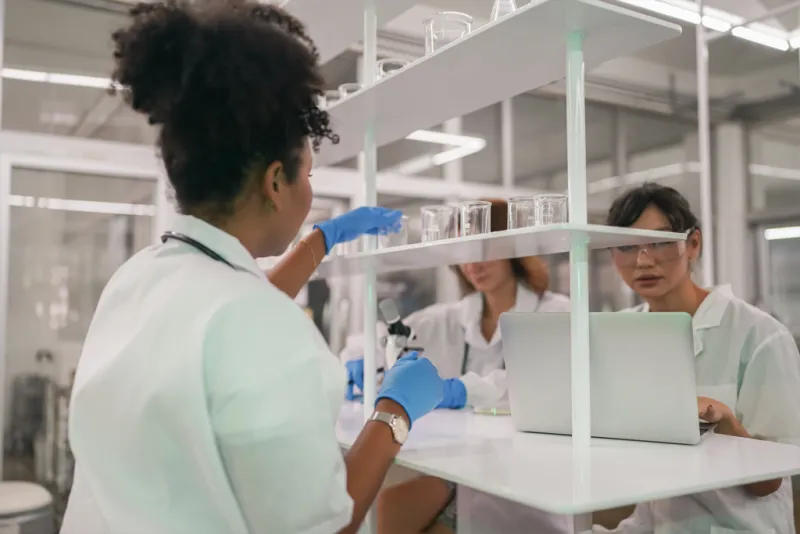
Photo: chemistry professional data analytics laboratory technology modern research, via img.freepik.com
The US chemical industry generates over half a trillion dollars in annual output and employs more than 500,000 workers directly, according to the American Chemistry Council. Yet beneath those impressive figures lies a growing structural vulnerability: the skills that employers are actively recruiting for today are not the skills that the available workforce reliably possesses. This is not a pipeline problem in the traditional sense — it is a translation problem, and it is becoming more expensive by the quarter.
At ChemsConnect, we sit at the intersection of the chemistry profession and the professional relationships that sustain it. What we hear from hiring managers, research directors, and department heads across the country is consistent: the technical foundation is often present, but the surrounding competency architecture — the ability to work across disciplines, communicate findings to non-specialist audiences, navigate regulatory frameworks, and apply computational tools to chemical problems — is frequently absent. These are not peripheral skills. They are increasingly the deciding factors in who advances, who gets funded, and which research programs achieve real-world impact.
Where the Shortfalls Are Most Visible
Green Chemistry and Sustainable Process Design
The transition toward sustainable chemistry is no longer a future consideration — it is a present operational reality for manufacturers, formulators, and research institutions alike. Federal regulatory pressure, investor expectations, and shifting consumer preferences have combined to make green chemistry fluency a core professional requirement across much of the sector.
Yet a 2023 workforce survey conducted by the ACS found that fewer than a third of respondents felt confident applying green chemistry principles beyond a conceptual level. The twelve principles of green chemistry are widely taught; their practical integration into process design, materials selection, and waste reduction strategies is far less consistently developed. Companies seeking process chemists who can simultaneously optimize yield and minimize environmental impact are finding the talent pool narrower than they anticipated.
Data Analytics and Computational Chemistry
The digitization of chemical research has accelerated dramatically in recent years, driven by advances in machine learning, high-throughput experimentation, and laboratory automation. The ability to work fluently with large datasets — to design experiments computationally, interpret statistical outputs, and apply predictive modeling to synthesis or formulation challenges — is now a meaningful differentiator in both industrial and academic chemistry roles.
Job postings across major US chemical employers increasingly list Python proficiency, familiarity with cheminformatics platforms, and experience with data visualization tools as preferred or required qualifications. The challenge is that many practicing chemists completed their graduate training before these tools became central to day-to-day research workflows, and continuing education in this area remains inconsistent.
Regulatory Affairs and Compliance
As the regulatory landscape governing chemical substances grows more complex — shaped by TSCA reform, evolving EPA guidance, state-level restrictions, and international harmonization requirements — demand for chemists who understand the regulatory dimension of their work has intensified sharply. This is particularly acute in specialty chemicals, pharmaceuticals, and consumer products.
Regulatory affairs roles in the US chemical sector are among the most difficult to fill, according to multiple recent industry talent surveys. The challenge is not simply a shortage of regulatory specialists; it is a shortage of bench chemists who possess enough regulatory literacy to collaborate effectively with compliance teams, anticipate submission requirements during the research phase, and avoid costly reformulation cycles downstream.
Science Communication
Perhaps the most underestimated gap in the current chemistry workforce is communicative. The ability to translate technical findings into accessible language — for policymakers, investors, media, and the general public — has become a genuine professional asset, particularly as public trust in scientific institutions remains a contested terrain.
Chemists who can write clearly for non-specialist audiences, present research compellingly to interdisciplinary stakeholders, and engage constructively with public skepticism are disproportionately valuable to their organizations. Graduate training has historically deprioritized these competencies. The market is now pricing them in.
Why Networking Is Part of the Solution
Identifying skill gaps is the straightforward part. Closing them requires a more nuanced strategy than simply enrolling in a certificate program — though targeted continuing education absolutely has a role to play. The more durable solution involves building the kinds of professional relationships that create ongoing access to expertise, perspective, and opportunity.
Consider the regulatory literacy gap. A synthetic chemist who lacks deep regulatory knowledge but maintains an active professional relationship with a regulatory affairs specialist gains something that no online course can fully replicate: real-time, contextualized guidance on how regulatory considerations apply to their specific work. The relationship creates a living knowledge resource that updates as the regulatory environment evolves.
Similarly, a chemist seeking to build computational skills benefits enormously from connecting with peers who are already proficient — not to outsource the learning, but to accelerate it through guided exposure, shared resources, and collaborative projects. This is precisely the kind of connection that platforms like ChemsConnect are designed to facilitate: purposeful professional relationships oriented around shared challenges and complementary expertise.
Positioning Yourself for High-Demand Roles
For individual chemists assessing their own positioning in this landscape, a few strategic considerations are worth articulating.
First, conduct an honest audit of your competency profile against the emerging demand signals described above. Where are the gaps relative to the roles you are targeting? Prioritize the areas where a targeted investment — a workshop, a collaborative project, a professional relationship — would yield the highest career leverage.
Second, resist the temptation to address skill gaps in isolation. Learning green chemistry principles from a textbook is less effective than learning them alongside a colleague who is already applying them in a production context. Seek out professionals whose expertise complements your gaps and engage with them substantively — through collaborative projects, co-mentorship arrangements, or professional community participation.
Third, make your developing competencies visible within your professional network. Publishing short-form commentary on a regulatory development you have been tracking, sharing a data visualization project you have been working on, or presenting a green chemistry case study at a local ACS meeting — these activities signal growth and attract the attention of collaborators and employers who are actively looking for the skills you are building.
The Structural Opportunity
Skill gaps are, by their nature, temporary. The chemistry community has navigated significant technical transitions before — from classical synthetic methods to combinatorial chemistry, from analog instrumentation to digital automation — and it will navigate these as well. The question is not whether the gaps will close, but how quickly, and who will be positioned advantageously when they do.
The answer, consistently, favors those who invest in professional relationships alongside technical skill development. The chemical sciences have always advanced through collaboration — between disciplines, between institutions, and between generations of scientists. The current moment of workforce transition is no different. It simply requires that those relationships be pursued with greater intentionality than the profession has historically demanded.
ChemsConnect exists to make that intentionality easier to act on. The skill gaps are real. The professional connections that help close them are available. The distance between those two facts is shorter than most chemists realize.