Beyond the Lab: 5 Unlikely Partnerships That Are Reshaping Modern Chemistry
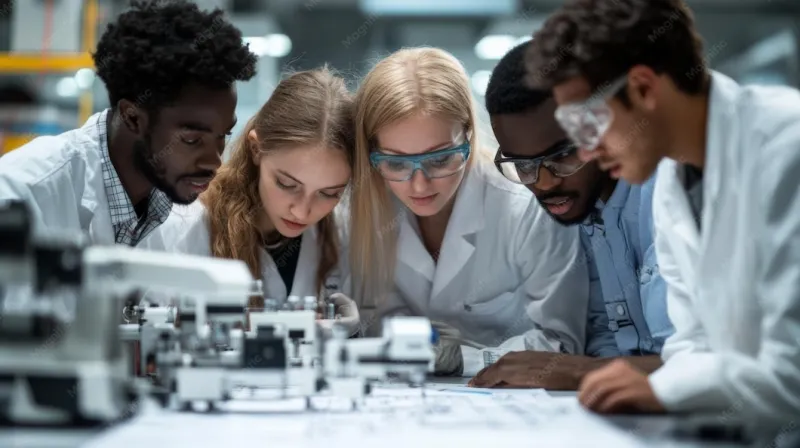
Photo: diverse scientists collaborating cross-disciplinary research team laboratory, via img.freepik.com
Chemistry has always been a foundational science—one that underpins medicine, agriculture, energy, and manufacturing in ways that rarely receive adequate public recognition. Yet for much of its modern history, the discipline has operated with a degree of insularity, its practitioners largely engaging with colleagues who share the same training, language, and professional culture.
That model is yielding to something more dynamic and, frankly, more exciting. The defining scientific achievements of the current era are increasingly the products of deliberate collaboration between chemists and professionals whose expertise lies in entirely different domains. At ChemsConnect, where our mission centers on bringing chemical minds together across boundaries, we have watched this trend accelerate with considerable interest.
The five partnerships described below are not hypothetical. They represent real collaborative models producing measurable outcomes—and they offer a compelling argument for why the future of chemistry depends on its practitioners reaching beyond their traditional networks.
1. Chemists and AI Engineers: Accelerating Drug Discovery at Machine Speed
The pharmaceutical industry has long operated on a sobering statistical reality: the vast majority of drug candidates fail before reaching clinical trials, and the process of identifying viable compounds is extraordinarily time-consuming. Computational chemistry has helped at the margins for decades, but the integration of modern machine learning into molecular design represents something categorically different.
At several research institutions and biotechnology firms across the United States, medicinal chemists are now working in direct, sustained partnership with AI engineers who specialize in deep learning and generative models. The collaboration functions as a genuine two-way exchange. Chemists provide the domain knowledge needed to define meaningful constraints—what makes a molecule synthetically accessible, metabolically stable, and pharmacologically relevant—while AI engineers develop and refine models that can explore chemical space far more efficiently than any human team.
The results have been striking. Several partnerships of this kind have produced novel compound candidates in months rather than years, with the AI models learning continuously from the chemists' experimental feedback. The key insight from those involved is that neither party could achieve comparable outcomes independently. The chemist without machine learning remains constrained by human cognitive bandwidth; the AI engineer without chemical expertise builds models that generate theoretically interesting but practically useless molecules.
For chemical professionals interested in entering this space, developing even a working familiarity with machine learning concepts—and connecting with AI practitioners through platforms like ChemsConnect—opens doors that were simply unavailable a decade ago.
2. Green Chemists and Environmental Economists: Putting a Price on Sustainable Synthesis
Green chemistry—the design of chemical products and processes that minimize hazardous substances and reduce environmental impact—has been a recognized subdiscipline for more than three decades. Yet despite its scientific merits, the adoption of greener synthesis routes in industrial settings has proceeded unevenly. One persistent obstacle has been the difficulty of making a compelling economic case for sustainability investments.
That barrier is being addressed through a growing partnership between green chemists and environmental economists. Researchers at several U.S. universities have been developing integrated frameworks that quantify the full lifecycle costs of chemical processes—incorporating regulatory compliance expenses, waste disposal, energy consumption, and long-term liability—alongside more conventional metrics of yield and efficiency.
When chemists and economists work from shared datasets and speak a common analytical language, the conversation with industrial decision-makers changes fundamentally. A greener process that appears more expensive at the synthesis step may reveal substantial cost advantages when downstream environmental and compliance costs are properly accounted for. This reframing has influenced procurement decisions at several major chemical manufacturers and has begun to shape how sustainability is evaluated in federal grant applications.
The collaboration requires genuine mutual education. Chemists must learn to express their work in terms of economic variables; economists must develop sufficient familiarity with chemical processes to build credible models. The investment in that shared fluency, however, is proving to yield significant returns for both disciplines.
3. Agricultural Scientists and Specialty Chemists: Reimagining Crop Protection Chemistry
The development of new agrochemicals—pesticides, herbicides, and fungicides—has traditionally proceeded as a largely chemistry-driven enterprise, with agricultural scientists serving primarily as end-stage evaluators of efficacy and safety. A more integrated model, in which agricultural scientists and chemists collaborate from the earliest stages of compound design, is producing meaningfully different outcomes.
Several research groups working on next-generation crop protection in the Midwest and Southeast have organized their work around joint problem-definition sessions in which agronomists, soil scientists, and synthetic chemists together identify the specific biological and environmental challenges that a new compound must address. This approach shifts the design target from a molecule with a particular chemical property to a solution for a defined agricultural problem—a subtle but consequential reorientation.
The practical results include compounds with more targeted modes of action, reduced soil persistence, and better compatibility with integrated pest management strategies. Equally important, this collaborative model tends to surface regulatory and environmental concerns earlier in the development process, reducing the likelihood of costly late-stage failures.
For chemists in this space, the ability to speak credibly about soil chemistry, plant biology, and agricultural economics—skills developed through sustained engagement with colleagues in those fields—is becoming a genuine professional differentiator.
4. Materials Chemists and Biotech Innovators: Engineering the Next Generation of Biomaterials
The boundary between materials chemistry and biotechnology has been dissolving steadily for years, but the pace of integration has accelerated markedly as demand has grown for materials that can interface directly with biological systems. Applications range from drug delivery platforms and tissue engineering scaffolds to biosensors and implantable devices.
The collaborations driving progress in this space are notable for their genuine intellectual symmetry. Materials chemists bring expertise in polymer design, surface functionalization, and mechanical property tuning. Biotech professionals contribute deep knowledge of cellular behavior, immunological response, and the biological constraints that determine whether a material will be tolerated by the body or rejected.
At research centers including several affiliated with major U.S. medical schools, these partnerships have produced materials with unprecedented combinations of properties—hydrogels that degrade at controlled rates in biological environments, nanoparticle systems that deliver therapeutic payloads to specific tissue types, and scaffold architectures that guide cell growth with precision previously unachievable.
The cultural learning required in these collaborations is substantial. Materials chemists accustomed to evaluating performance in terms of tensile strength or thermal stability must develop fluency in biological metrics; biotech researchers must develop appreciation for the constraints of scalable synthesis. The effort, by all accounts, is worthwhile.
5. Process Chemists and Mechanical Engineers: Decarbonizing Chemical Manufacturing
The chemical industry accounts for a significant share of U.S. industrial energy consumption and greenhouse gas emissions. Decarbonizing chemical manufacturing is therefore not merely an environmental aspiration but an economic and regulatory imperative that is already reshaping capital investment decisions across the sector.
Progress on this front is emerging from a partnership model that pairs process chemists with mechanical engineers specializing in reactor design, heat integration, and electrification. Traditionally, these two groups operated in relative isolation—chemists defining the reaction conditions, engineers designing the equipment to accommodate them. A more integrated approach, in which both parties collaborate on process design from the outset, is enabling innovations that neither discipline would reach independently.
Specific outcomes include electrochemical synthesis routes that replace energy-intensive thermal processes, reactor configurations that recover and reuse heat more effectively, and process intensification strategies that reduce both energy demand and capital footprint. Several pilot projects at U.S. chemical facilities have demonstrated that this integrated design approach can reduce energy consumption by meaningful percentages compared with conventional process development.
For process chemists, developing a working understanding of mechanical and electrical engineering principles—and actively seeking collaborative relationships with engineers who share a commitment to sustainability—is increasingly essential professional preparation.
The Connective Imperative
Each of the five partnerships described above shares a common prerequisite: the willingness of professionals to step outside their disciplinary comfort zones and engage seriously with the knowledge and perspectives of people trained very differently from themselves. That willingness does not emerge automatically from proximity. It requires deliberate cultivation—through professional networks, shared problem spaces, and platforms designed to facilitate exactly this kind of cross-disciplinary encounter.
At ChemsConnect, we believe that the most important scientific breakthroughs of the coming decade will emerge not from isolated laboratories but from the intersections between disciplines that have not historically communicated. Fostering those connections—between chemists and AI engineers, economists, biologists, agricultural scientists, and mechanical engineers—is precisely the work our community exists to support.
The chemistry that will define the next generation of innovation is already being written, at the boundaries where disciplines meet. The professionals who position themselves at those boundaries, and who invest in the relationships that make genuine collaboration possible, will be the ones helping to write it.