Crossing the Line: How Chemists Are Reinventing Their Careers Across Industries
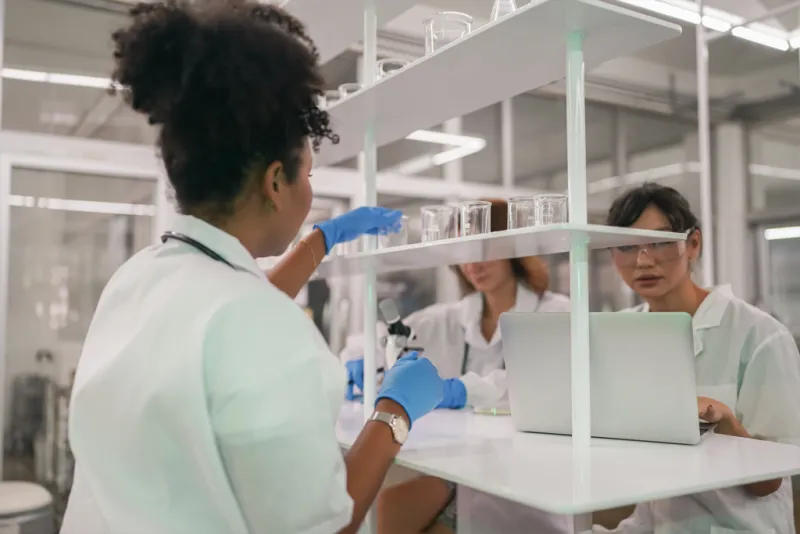
Photo: chemist professional career transition laboratory to office meeting, via lifepathlab.co.za
For decades, career trajectories in the chemical sciences followed a relatively predictable arc. A medicinal chemist would spend a career in pharma. A polymer scientist would find a home at a materials firm and stay put. The unspoken expectation was that specialization meant permanence. That assumption is now being dismantled—quietly, deliberately, and with impressive results.
Across the United States, a meaningful shift is underway. Chemical professionals at every career stage are leveraging their foundational training to move into sectors they were never formally educated in. And platforms like ChemsConnect are increasingly serving as the connective tissue that makes those transitions visible, viable, and collaborative.
Why the Pivot Is Happening Now
Several converging forces are accelerating cross-sector movement in the chemical sciences. Industry consolidation in pharmaceuticals has led to waves of layoffs among experienced researchers, pushing talented professionals to explore adjacent fields. Meanwhile, the rapid expansion of sectors such as clean energy, sustainable materials, and biotechnology has created urgent demand for scientific talent that new graduates alone cannot satisfy.
Beyond structural factors, there is a generational dimension at play. Many mid-career chemists report that intellectual curiosity and a desire for broader impact are driving them to reconsider what their expertise can accomplish in a different context. The pandemic period, which disrupted laboratory routines and prompted widespread professional reflection, accelerated this reckoning for many.
From Pharma Bench to Materials Science: A Common Transition
One of the most frequently observed career pivots in the chemical community runs from pharmaceutical research toward materials science and engineering. On the surface, the leap appears significant—synthetic organic chemistry applied to drug candidates seems far removed from polymer development or battery electrolyte design. In practice, the overlap is substantial.
Consider the case of a synthetic chemist who spent eight years developing small-molecule therapeutics at a mid-size pharma company in New Jersey. When that organization underwent restructuring, she began exploring opportunities in the battery materials space—an area experiencing explosive growth driven by the electric vehicle market. Her understanding of reaction mechanisms, her facility with analytical instrumentation, and her experience managing multi-step synthesis workflows translated directly into her new role at a materials startup in Michigan. Within two years, she had co-authored patents in a field she had not formally studied.
Her story is not unique. ChemsConnect community discussions frequently feature professionals describing analogous transitions, noting that the ability to design and interpret experiments is a universal currency that crosses sector boundaries with relative ease.
Academic to Industrial: Bridging the Culture Gap
Perhaps no pivot carries more cultural weight than the move from academic research to industrial application. The two environments operate on fundamentally different timelines, incentive structures, and definitions of success. A university researcher accustomed to publishing results in peer-reviewed journals must adapt to a world where proprietary knowledge is guarded, timelines are compressed, and commercial viability shapes every decision.
Chemists who have navigated this transition successfully often point to a few critical adjustments. First, reframing how one communicates value—shifting from citation counts and grant funding to cost savings, process efficiency, and product performance metrics—is essential. Second, learning to work within cross-functional teams that include engineers, regulatory specialists, and business development professionals requires a different kind of collaboration than the academic lab typically demands.
For those making this move, the connections available through professional networks like ChemsConnect can be invaluable. Speaking directly with industrial chemists who have walked the same path—and who can describe the practical realities of the transition—compresses the learning curve considerably.
Corporate R&D to the Startup World
Another pivot gaining momentum involves experienced corporate researchers moving into early-stage startup environments. Large chemical and materials companies offer stability, resources, and infrastructure, but they can also impose bureaucratic constraints that frustrate scientists eager to see their work move quickly from concept to application.
Startups in the chemical space—particularly those working on green chemistry, specialty ingredients, and advanced manufacturing—actively recruit professionals who bring both deep technical knowledge and an understanding of how larger organizations operate. A process chemist who spent fifteen years at a Fortune 500 company in Houston, for example, may bring irreplaceable knowledge about scale-up challenges, supply chain considerations, and regulatory compliance that a founding team of recent PhD graduates simply cannot replicate.
The tradeoffs are real. Compensation structures shift, job security diminishes, and the scope of individual responsibility expands dramatically. Yet many professionals who have made this move describe a renewed sense of ownership over their work and a direct line between their daily efforts and meaningful outcomes.
Transferable Skills That Transcend Sector Boundaries
Regardless of which direction a career pivot takes, certain competencies appear consistently among those who transition successfully. Problem-solving under constraint—the ability to design experiments, interpret ambiguous data, and adjust hypotheses in real time—is perhaps the most universally applicable skill a chemist possesses. It is valued in pharmaceutical development, materials research, environmental consulting, and regulatory affairs alike.
Analytical instrumentation proficiency, familiarity with safety and compliance frameworks, and experience with technical writing also travel well across sectors. Increasingly, computational skills—whether in molecular modeling, data analysis, or process simulation—are serving as powerful differentiators for chemists entering fields that might not have traditionally recruited from their background.
Soft skills matter equally. The capacity to communicate complex scientific concepts to non-specialist audiences, to collaborate across disciplines, and to manage projects with competing priorities is consistently cited by hiring managers across sectors as a deciding factor in evaluating candidates making non-traditional moves.
Practical Steps for Professionals Considering a Pivot
For those contemplating a sector change, the path forward benefits from deliberate preparation. Several practical steps can meaningfully improve the odds of a successful transition.
Audit your transferable assets honestly. Map your technical skills, instrumentation experience, and domain knowledge against the requirements of your target sector. Identify genuine gaps early so you can address them before they become obstacles in a hiring process.
Build connections before you need them. Platforms like ChemsConnect exist precisely to facilitate the kind of cross-sector dialogue that accelerates career transitions. Engaging with professionals already working in your target field—asking specific questions, following relevant discussions, and participating in community conversations—provides insight that no job description can offer.
Pursue targeted credentialing where it matters. In some cases, a short course in regulatory affairs, a certificate in data science, or attendance at a sector-specific conference can signal genuine commitment to a new field and fill knowledge gaps that might otherwise give a hiring manager pause.
Reframe your narrative. How you describe your experience matters as much as the experience itself. Translating your background into the language of your target sector—demonstrating that you understand its priorities, challenges, and terminology—is a skill worth developing before your first interview.
The Broader Significance of Career Mobility in Chemistry
The willingness of chemical professionals to move across sectors carries implications that extend beyond individual careers. When a pharmaceutical chemist brings her mechanistic thinking to battery research, or when a corporate process engineer applies his scale-up expertise to a green chemistry startup, knowledge transfers in ways that formal education and training rarely achieve. These cross-pollination effects accelerate innovation and strengthen the broader scientific ecosystem.
At ChemsConnect, we observe this dynamic regularly in the connections our community members form and the collaborations that emerge from them. The chemistry career pivot, far from representing professional instability, increasingly signals adaptability, intellectual range, and a commitment to applying scientific expertise where it can have the greatest impact. For those willing to make the move, the opportunities—and the professional community ready to support them—have never been more accessible.