The Six Skills Quietly Determining Who Rises in Chemistry — and Who Doesn't
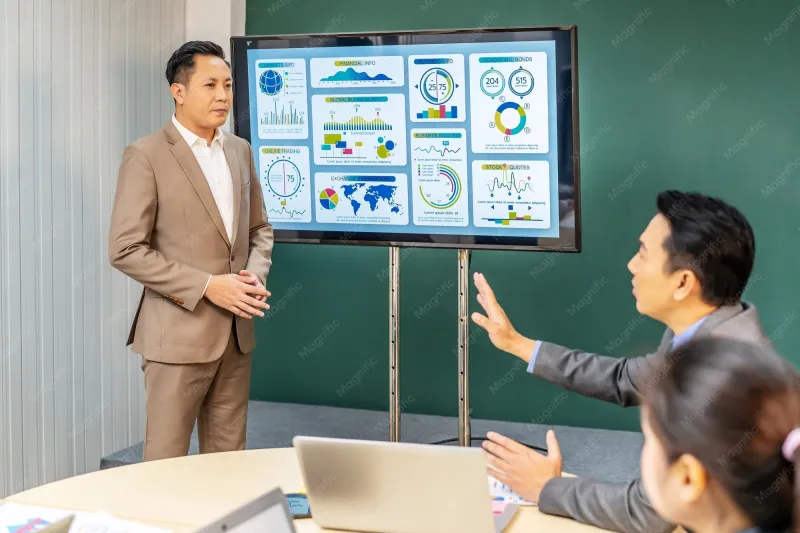
Photo: professional chemist presenting data business meeting leadership, via img.freepik.com
The job posting asked for a Ph.D. in organic chemistry, five years of synthesis experience, and proficiency with standard analytical instrumentation. What it did not mention — what almost none of them mention — was that the candidate who ultimately got the role had spent two years leading cross-functional project teams and could present a business case to a non-technical audience without losing the room.
"We had twelve applicants with stronger pure chemistry credentials," said the hiring manager at a specialty chemicals firm in New Jersey, who agreed to speak on background. "She was the one who understood that her job was not just to run reactions. It was to make the rest of the organization understand why the reactions mattered."
This scenario is playing out with increasing frequency across the US chemical industry, in academic research settings, and at the growing intersection of chemistry and technology. The field is not abandoning technical rigor — but it is quietly, and in some quarters urgently, expanding its definition of what competence actually looks like.
Here are the six non-chemistry skills that are reshaping chemistry careers.
1. Science Communication: Translating the Bench for the Boardroom
The ability to communicate complex scientific concepts to non-expert audiences — executives, regulators, investors, journalists, and the general public — has moved from a "nice to have" to a functional requirement at many organizations.
"I can teach someone analytical techniques," said a vice president of R&D at a publicly traded chemical company. "I cannot easily teach them how to explain a 500-page regulatory submission to a congressional staffer in four minutes. That skill is rare, and we pay for it."
For early-career chemists, this means treating every presentation, every written report, and every cross-departmental meeting as an opportunity to build translation fluency. Organizations such as the American Chemical Society offer science communication training, and an increasing number of graduate programs are embedding communication coursework directly into chemistry curricula.
2. Data Storytelling: From Numbers to Narrative
Chemistry has always been a data-intensive discipline. What has changed is the expectation around what researchers do with that data once it is generated. In an era of high-throughput experimentation, computational modeling, and AI-assisted analysis, the bottleneck is no longer data collection — it is interpretation and communication.
Data storytelling is the practice of constructing a clear, evidence-based narrative from quantitative information in a way that drives decisions. It is distinct from data visualization (though that is a component) and from statistical analysis (though that is a prerequisite). It is the connective tissue between a dataset and an action.
"The chemists who get promoted into leadership are almost always the ones who can walk into a meeting with results and tell you what those results mean for the next six months of strategy," said one C-suite executive at a Midwest-based agrochemical company. "That is not a chemistry skill. That is a storytelling skill."
3. Project Management: The Invisible Architecture of Research
Chemistry departments and R&D organizations are, at their core, project-based environments. Experiments have timelines, budgets, dependencies, and stakeholders. Yet formal project management training remains conspicuously absent from most chemistry degree programs.
The consequences are predictable. Research timelines slip. Resources are misallocated. Teams duplicate work. Promising projects stall not because the science failed but because the coordination did.
Professional certifications such as the Project Management Professional (PMP) designation are increasingly appearing on the resumes of mid-career chemists — not as a pivot away from science, but as a deliberate signal that the candidate understands how research actually gets done in complex organizations.
"Every project I have ever seen fail in this industry failed for a management reason, not a chemistry reason," noted one senior director of process development. "The chemistry was fine. The communication was not. The timeline was not. The hand-off was not."
4. Systems Thinking: Seeing the Molecule and the Machine
Chemistry education trains practitioners to think reductively — to isolate variables, control conditions, and examine phenomena at the molecular level. This is scientifically essential. It is also, in applied and industrial contexts, insufficient on its own.
Systems thinking — the capacity to understand how components interact within larger networks, and how changes in one part of a system propagate through the whole — is increasingly valued in roles that sit at the intersection of chemistry and manufacturing, supply chain, environmental compliance, and product development.
A process chemist who understands only the reaction cannot anticipate how a raw material shortage will cascade through production. A formulation scientist who cannot map their product through a regulatory and commercial pipeline is limited in their ability to advocate for it internally. Systems thinking transforms technical experts into strategic contributors.
5. Negotiation and Stakeholder Management: The Politics of Science
This is the skill that most chemists are least comfortable acknowledging — and the one that may most directly determine career ceiling.
Every significant research initiative involves competing priorities, limited resources, and stakeholders with divergent interests. The ability to navigate those dynamics — to advocate for resources, build internal coalitions, manage up and across organizational hierarchies, and negotiate timelines and deliverables without damaging relationships — is what separates researchers who lead programs from those who execute them.
"Chemistry is political," said one career coach who works exclusively with STEM professionals in the US. "Not in a cynical way — in a human way. The people who pretend otherwise are usually the ones calling me after they've been passed over for the third time."
Negotiation training, executive communication workshops, and even structured mentorship through platforms like ChemsConnect can help researchers build these competencies in environments that feel lower-stakes than their primary workplace.
6. Intellectual Curiosity Beyond Chemistry: The Adjacent Possible
The sixth skill is the hardest to teach and the easiest to underestimate: genuine, applied curiosity about fields adjacent to chemistry.
The most consequential innovations in the chemical sciences over the past decade — from mRNA lipid nanoparticle delivery systems to biodegradable polymer design — emerged from researchers who were as fluent in biology, materials science, computational modeling, or engineering as they were in their primary discipline. The same pattern holds in industry: the chemists who drive the most value are often those who understand enough about adjacent domains to recognize where chemistry can solve a problem that another field has been unable to crack.
This is not about becoming a generalist. It is about cultivating what innovation theorists call "T-shaped" expertise — deep in one domain, broadly literate in many.
The Competency Shift Is Already Underway
For chemists navigating this evolving landscape, the message from hiring managers, executives, and career practitioners is consistent: technical mastery remains the price of entry, but it is no longer the price of advancement. The professionals who are building the most durable and influential careers in the chemical sciences are those who have understood — often earlier than their peers — that the discipline's greatest challenges are as much human as they are molecular.
Building those capabilities does not require abandoning the bench. It requires recognizing that the bench is one part of a much larger system — and that understanding the whole system is now part of the job.