When Luck Becomes a Liability: The Hidden Cost of Informal Collaboration in Chemistry
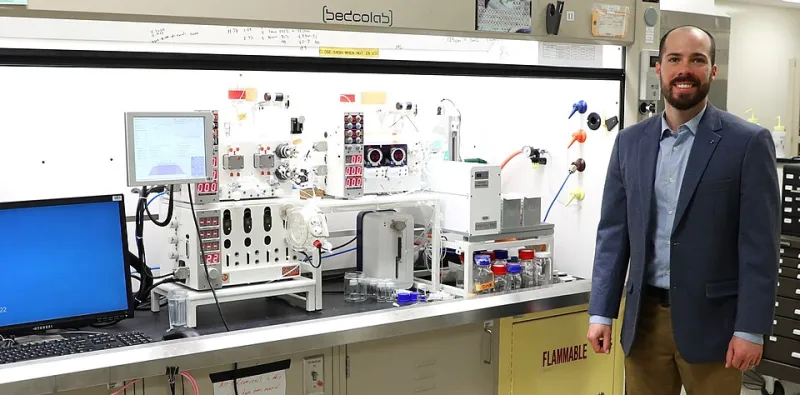
Photo: U.S. Air Force AFRL by Jonathan Taulbee, Public domain, via Wikimedia Commons
Chemistry has long romanticized the accidental discovery. From Perkin's mauveine to the serendipitous crystallography breakthroughs that reshaped structural biology, the field's mythology is populated with stories of productive coincidence. Researchers and institutions frequently celebrate informal networking—the spontaneous lab visit, the impromptu conference exchange—as a primary engine of interdisciplinary progress.
But what if the reliance on these chance encounters is doing more harm than good?
A closer examination of collaboration patterns across US research institutions reveals an uncomfortable reality: the same informal networks that researchers credit with their most transformative partnerships are often the networks most prone to reproducing existing hierarchies, concentrating resources among established groups, and excluding early-career scientists and underrepresented communities who lack access to the right social environments.
The Myth of the Productive Accident
When chemistry professionals describe their most meaningful collaborations, they frequently invoke language of chance: we just happened to be at the same symposium, or I ran into her at a departmental seminar and the conversation took off. These narratives are compelling precisely because they feel organic—untainted by institutional agenda or deliberate strategy.
The problem is that they obscure a more structured reality. The researchers who "happen" to meet at the right symposium are overwhelmingly those who had the funding to attend, the institutional affiliation to be invited, and the social capital to be introduced by mutual contacts. Serendipity, in this context, is not random. It is heavily weighted toward those who are already well-positioned within the field.
Data from the National Science Foundation's collaborative grant portfolios consistently show that co-investigator networks cluster around a relatively small number of high-output institutions—MIT, Caltech, Stanford, large Big Ten research universities—while chemists at smaller regional universities, minority-serving institutions, and community colleges remain structurally peripheral, regardless of the quality of their work. When collaboration is left to chance, geography, prestige, and pre-existing social ties become the de facto selection criteria.
What Practitioners Are Actually Experiencing
Conversations with working chemists across the US reveal a tension that rarely surfaces in formal discussions about research collaboration. Senior researchers at well-funded institutions often describe their networks as diverse and open, pointing to collaborators from different subdisciplines or from industry as evidence of breadth. Yet when pressed on how those collaborations originated, the pathways almost invariably trace back to shared graduate programs, mutual advisors, or elite conference circuits.
Early-career chemists, particularly those from historically underrepresented backgrounds, describe a different experience entirely. Many report that the informal networking culture—the after-hours receptions, the invitation-only workshops, the mentorship relationships that form over golf or faculty club dinners—creates an environment in which professional proximity to power matters more than scientific merit. The collaboration opportunities that appear serendipitous to those inside the network are effectively invisible to those outside it.
This is not simply a matter of individual exclusion. When the same clusters of researchers repeatedly collaborate with one another, the range of questions being asked, the methodologies considered legitimate, and the applications deemed worthy of pursuit all narrow accordingly. Disciplinary silos are not broken down by chance encounters between people who already know each other.
The Architecture of Intentional Collaboration
The institutions and research programs that have most effectively broken down disciplinary barriers share a common characteristic: they treat collaboration as a designed system rather than an emergent phenomenon.
The NSF's Chemistry Centers program, for instance, has long required explicit articulation of how interdisciplinary teams will be structured, how credit will be shared, and how early-career researchers will be integrated into collaborative workflows. The most successful centers in this portfolio are not those that simply brought talented people into proximity and hoped for sparks—they are those that established deliberate mechanisms for knowledge exchange, including structured cross-disciplinary seminars, co-mentorship arrangements, and formalized processes for incorporating external expertise.
Similarly, pharmaceutical and specialty chemical companies that have invested in systematic collaboration architecture—structured ideation sessions, cross-functional project teams with explicit diversity mandates, and digital platforms that surface expertise across organizational silos—consistently report shorter development timelines and higher rates of novel discovery than those that rely on organic relationship-building alone.
The lesson is not that serendipity has no value. Unexpected connections remain one of the genuine pleasures and productive features of scientific life. The lesson is that serendipity cannot be the strategy. When it is treated as such, it functions as a mechanism for perpetuating the status quo rather than disrupting it.
Rethinking What "Good" Collaboration Looks Like
For chemistry professionals and research administrators, this analysis demands a recalibration of how collaboration success is defined and rewarded. Several principles are worth considering.
Audit your existing network for structural gaps. Most researchers, if they map their active collaborators honestly, will find that their networks are narrower than they appear. Diversity of institution type, career stage, subdiscipline, and demographic background are all meaningful indicators of whether a collaboration ecosystem is genuinely open or simply feels that way.
Distinguish between access and invitation. Informal networking events, conference socials, and mentorship relationships that are nominally open to all are not equitably accessible. Institutions committed to broadening participation in chemistry research need to move beyond open-door policies and toward active outreach and structured inclusion mechanisms.
Treat collaboration infrastructure as a scientific resource. The tools, platforms, and processes that facilitate connection across institutional and disciplinary boundaries deserve investment comparable to laboratory equipment. Platforms designed specifically for the chemical sciences—those that allow researchers to surface complementary expertise, identify potential co-investigators, and build partnerships around specific scientific questions—represent a meaningful step toward making collaboration less dependent on social luck.
Credit intentional network-building as professional practice. In a field that still primarily rewards individual publication records, the work of building and sustaining collaborative relationships is systematically undervalued. Changing this requires deliberate action at the level of tenure review, grant evaluation, and departmental culture.
The Broader Implication for the Field
Chemistry is navigating a period of extraordinary scientific possibility—at the intersections of materials science and biology, computational modeling and synthetic chemistry, environmental science and industrial process design. The breakthroughs most likely to define the next decade will not emerge from within any single disciplinary tradition. They will require sustained, substantive collaboration across boundaries that informal networking has historically reinforced rather than dissolved.
The serendipity narrative, however appealing, is ultimately a story about the past. It describes how collaboration worked when the field was smaller, less diverse, and less globally connected. Building the collaborative infrastructure that the next generation of chemistry research actually requires means moving beyond romanticized accident and toward something more deliberate, more equitable, and more architecturally sound.
For researchers, educators, and professionals across the chemical sciences, the question is no longer whether intentional network design matters. The evidence is clear that it does. The question is whether the field is willing to do the harder work of building it.